Trust No Face: A Field Guide to Spotting AI-Generated People Before They Deceive You
Not long ago, the word "deepfake" conjured images of elaborate Hollywood-style productions — sophisticated forgeries requiring expensive hardware and specialized expertise. That era is over. The same generative AI tools that can produce a convincing portrait of a person who has never existed are now accessible to anyone with a browser and a free account. The barrier to creating a synthetic identity has collapsed. The burden of detecting one has shifted, almost entirely, to you.
For most Americans, the practical threat is not a state-sponsored disinformation campaign or a celebrity video scandal. It is a job applicant on a video interview who is not who they claim to be. It is a romantic interest on a dating app whose profile photograph was assembled by an algorithm. It is a customer service representative whose face tracks slightly wrong during a video call. These are the contexts in which deepfakes are increasingly being deployed against ordinary people — and they are the contexts this guide addresses.
Why Detection Tools Alone Are Not Enough
Several detection platforms claim to identify AI-generated images and video with high accuracy. Some of them work reasonably well under controlled conditions. In practice, however, they face a fundamental problem: the same rapid advancement that makes synthetic media more convincing also erodes the reliability of any detection method calibrated to yesterday's generation of tools. A detector trained on outputs from one AI model may perform poorly against content produced by a newer one.
More critically, the average person encountering a potential deepfake in real time — during a live video call, while scrolling a dating app, or reviewing a job application — does not have the opportunity to run a file through a detection platform. What they need is a set of observable, behavioral, and contextual signals that remain relatively stable even as the underlying technology evolves. That is what follows.
Visual Anomalies That Persist Across Generations
Current generative AI systems, despite their impressive outputs, share certain persistent failure modes. These are not guaranteed to appear in every synthetic image or video, but their presence significantly elevates suspicion.
Lighting inconsistency. Human faces exist in environments with complex, multi-directional light sources. AI-generated faces frequently display lighting that is internally consistent — the face is evenly and attractively lit — but inconsistent with the background or setting. Shadows that don't match the apparent light source, or a face that appears brighter than its surroundings without obvious explanation, warrant scrutiny.
Edge artifacts around hair and skin. The boundary where hair meets the background is one of the most computationally difficult areas for generative models. Look for a subtle blurring, a faint halo, or an unnaturally smooth gradient at these edges. This is particularly evident in profile photographs on social media or dating platforms.
Symmetry that exceeds biological norms. Human faces are asymmetrical in small but consistent ways. AI-generated faces tend toward a hyper-symmetry that reads as attractive but slightly uncanny upon close examination. If a face appears almost perfectly balanced in a way that feels more like a composite than a photograph, that impression is worth taking seriously.
Inconsistent details under magnification. Earrings that differ between ears, eyeglass frames that distort where they meet the face, and teeth that blur into an indistinct mass rather than resolving into individual structures are recurring artifacts in AI-generated imagery. On a desktop or tablet, zooming in on these areas can surface anomalies that are invisible at normal viewing size.
Behavioral Red Flags in Live Video
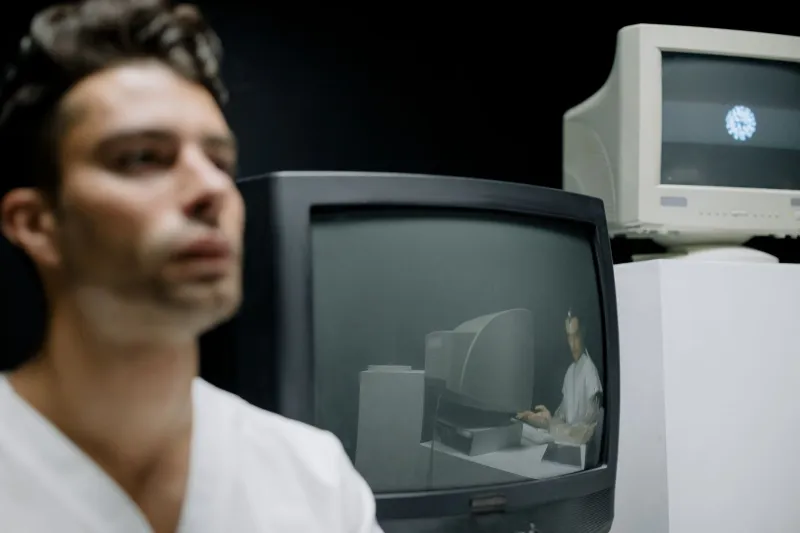
Static image detection is one challenge. Live video deepfakes — increasingly used in fraudulent job interviews and romance scams — present a different set of signals.
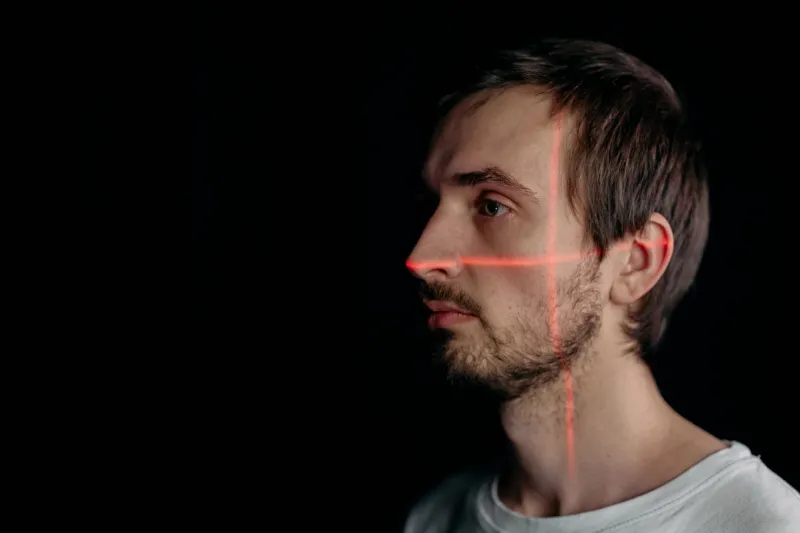
Resistance to spontaneous requests. A legitimate person on a video call can comply immediately with a request to turn their head to the side, look down at their keyboard, or hold a specific object up to the camera. Real-time deepfake systems struggle with sudden, unpredictable movements and often introduce lag, distortion, or a brief freeze when confronted with angles or actions they were not calibrated to handle. Asking a new contact to perform a simple, specific physical action — particularly one that requires showing a profile view — is one of the most reliable informal tests available.
Lip-sync irregularities. Even in high-quality deepfake video, the synchronization between spoken words and lip movement occasionally drifts, particularly during rapid speech, fricative consonants, or moments of emotional emphasis. Watch the mouth carefully during natural conversation rather than prepared statements.
Unnatural blinking patterns. Early-generation deepfakes were notoriously deficient in blinking. Newer models have partially corrected this, but blinking that occurs too infrequently, too regularly, or at moments that don't correspond to natural conversational rhythm remains a detectable signal.
Background inconsistency during movement. When a person moves laterally in a live deepfake feed, the background sometimes fails to respond correctly to the shift in perspective. A background that appears to "swim" or distort slightly when the subject moves is a meaningful warning sign.
Contextual and Behavioral Patterns
Beyond the visual, the circumstances surrounding a potential deepfake often contain signals that are just as informative.
In the context of dating applications, the FBI's Internet Crime Complaint Center has documented a significant increase in romance fraud cases in which AI-generated profile photographs are used to establish initial credibility. Profiles that feature a single, unusually polished photograph, that resist video calls, or that escalate emotional intimacy far more rapidly than context warrants should be approached with structured skepticism. Requesting a video call early in any online relationship — before financial requests or personal disclosures occur — remains one of the most effective informal filters available.
In professional contexts, the remote-work hiring boom has created conditions that fraudsters have actively exploited. The FBI issued a public service announcement in 2022 specifically warning employers that applicants were using deepfake video technology to misrepresent their identities during remote interviews. Hiring managers should note whether an applicant's responses appear slightly delayed relative to questions, whether facial expressions correspond naturally to the emotional content of their words, and whether the applicant's claimed credentials can be verified through channels entirely independent of the interview itself.
In customer service interactions — particularly those involving financial accounts, healthcare, or legal matters — unsolicited video contact from a representative should be treated with caution regardless of how convincing the visual presentation appears. Legitimate institutions generally do not initiate sensitive conversations through video calls without prior arrangement.
The Verification Instinct
The underlying principle connecting all of these observations is the same: synthetic media is optimized for passive consumption. It is designed to be convincing when viewed without interrogation. The moment you introduce active, unpredictable verification — a specific physical request, an independent callback to a verified number, a reverse image search, a spontaneous and unscripted conversational detour — the system's limitations become more apparent.
The burden of verification has not always rested so heavily on ordinary users. For much of the internet's history, a face on a screen carried an implicit presumption of authenticity. That presumption is no longer warranted. Extending trust to a digital identity now requires the same deliberate, evidence-based reasoning that the best fraud investigators apply professionally — not because paranoia is a reasonable default, but because the cost of misplaced trust has risen sharply, and the tools for misplacing it have never been more accessible.
Deepfake detection is not primarily a technical problem. It is a habit of attention. Cultivating that habit — asking one more question, requesting one more verification, pausing before one more disclosure — is the most durable protection currently available to anyone navigating a media environment in which seeing is no longer believing.